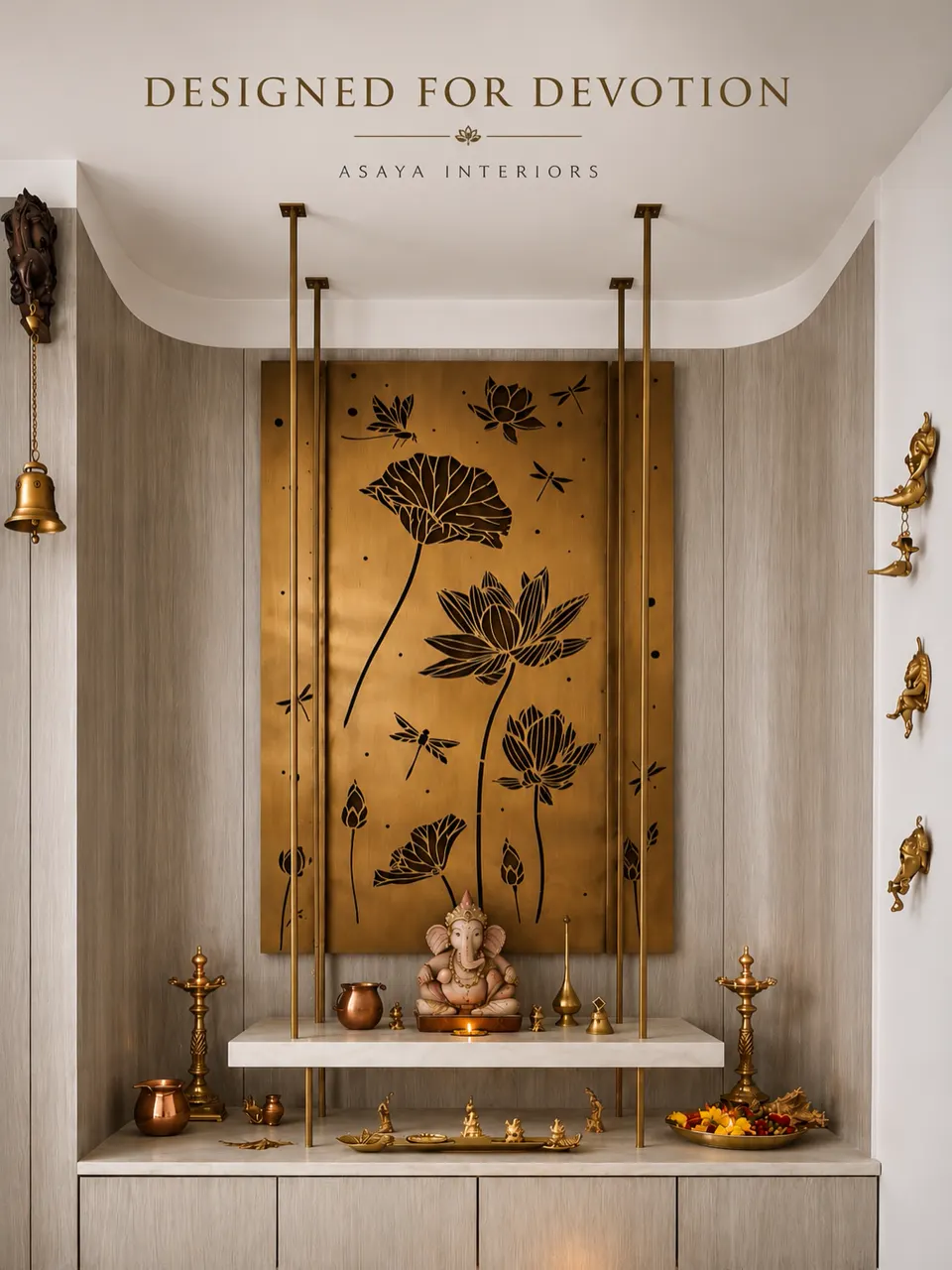
Pooja room design ideas: what makes a mandir feel right
A good pooja space is quiet, well lit, easy to clean and placed with care, usually in the north-east of the home. Design should support the ritual: a place for the idols, a surface for the diya, storage for samagri and room to sit or stand comfortably.
Modern pooja rooms honour tradition while embracing contemporary design. Instead of heavy carved wood everywhere, many families now choose a backlit jaali or lotus panel, a stone or stone-look base, brass accents and hidden drawers. The aim is a space designed for devotion, where every detail is intentional and nothing distracts.
Start by listing how your family prays. Do you sit on the floor or stand? How many idols and frames need space? Do you perform a daily aarti with a large diya, or light a small lamp? Is there a need to store scriptures, a bell, a kalash or festive decorations? These answers decide the platform height, depth, storage and ventilation long before any finish is chosen. A mandir that fits the ritual will feel right every day, while one designed only for looks can become awkward within weeks.
Mandir design as per vastu: key guidelines
Vastu traditionally recommends the north-east (Ishaan) corner for the pooja space, with the worshipper facing east or north while praying. Where that is not possible, east or north walls are commonly preferred alternatives.
- Direction: north-east is preferred; east and north are good alternatives.
- Idol placement: idols are usually placed slightly above floor level, often so that they are around chest height when seated or standing, and not directly touching the wall.
- Avoid: placing the mandir under a staircase, against a toilet wall, or directly facing a bathroom door.
- Bedrooms: if the mandir must be in a bedroom, many families prefer the north-east corner with a door or curtain to close it at night.
- Colours: light, calm shades such as white, cream, pale yellow and soft wood tones.
- Doors: two-leaf doors or jaali shutters are traditional; bells on doors are a personal choice.
- Storage: keep samagri in closed drawers below; avoid storing unrelated items above the idols.
Vastu practices vary between families and regions, so treat these as widely followed guidelines rather than strict rules. Our vastu tips for home interiors cover the rest of the home, and our vastu-compliant interior design service plans layouts with these principles in mind.


Pooja ideas for small flats
In compact apartments, a wall-mounted or niche mandir in the living or dining area often works better than a separate room. Careful design can still make it feel dedicated.
1. Wall-mounted unit
A floating shelf with a backlit panel and a drawer below, typically 600–900mm wide. It saves floor space and is easy to clean beneath.
2. Recessed niche
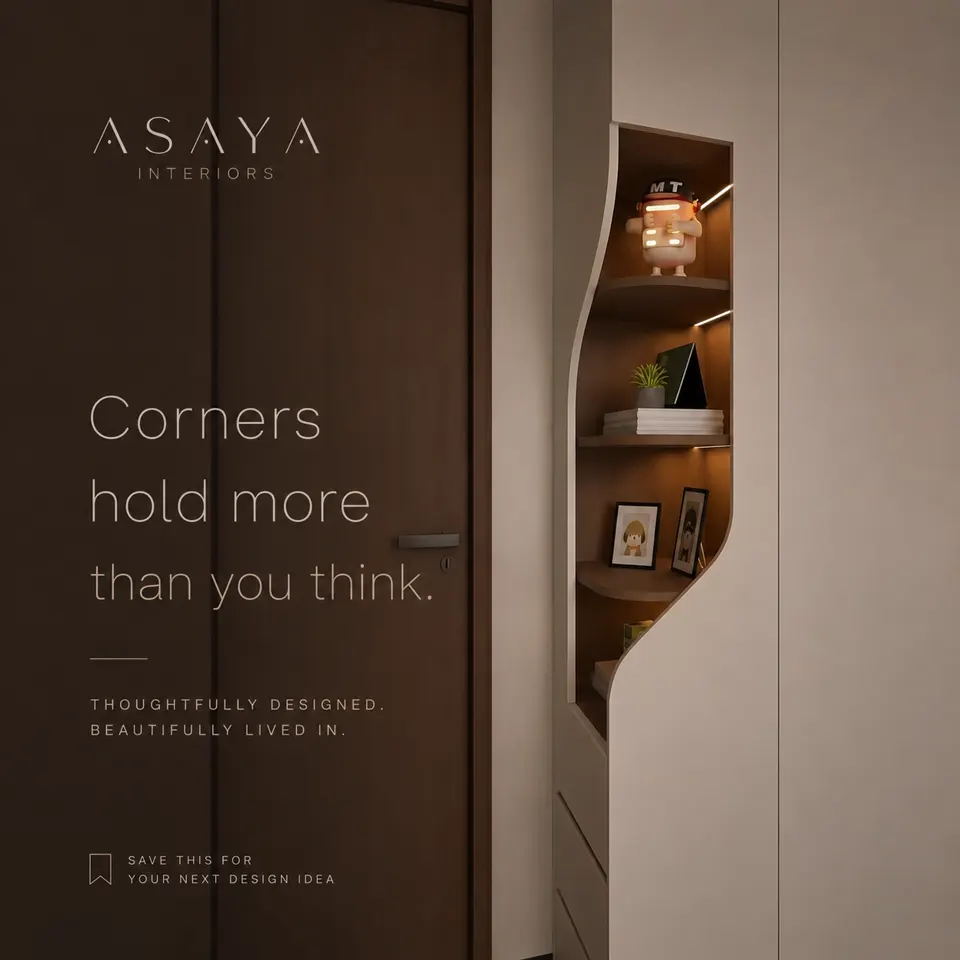
A niche carved into a wall or a wardrobe run, finished in stone-look laminate or veneer, with a curved or arched top for a softer form.
3. Corner mandir
A triangular or L-shaped unit in the north-east corner of the living room, with fluted or jaali shutters that close after prayer.
4. Mandir with sliding doors
A tall unit that looks like part of a storage wall when closed and opens to reveal a lit shrine.
5. Pooja partition
A jaali screen separating a small prayer zone from the dining area, offering privacy without blocking light.
More compact layouts are in our small apartment interior ideas.
Ideas for separate pooja rooms in villas and kothis
A dedicated pooja room can be designed as a calm, layered space with a feature wall, a raised platform and seating. Larger homes allow more expression.
- A marble or stone-look platform (about 300–450mm high) for idols, with a step down to a sitting area.
- A backlit lotus, mandala or jaali panel as the backdrop.
- Carved or CNC-cut double doors with frosted or fluted glass.
- A small bell or diya niche on the side walls.
- Built-in low storage for scriptures, puja thalis and festive items.
- A floor cushion or low bench for comfortable sitting.
- Ventilation or an exhaust to clear incense smoke.
Materials for a durable pooja unit
Choose heat-safe and easy-clean materials near the diya, and warm, natural finishes elsewhere.
| Material | Where to use | Why |
|---|---|---|
| Marble or quartz | Base, diya platform | Heat resistant, easy to wipe, traditional feel |
| Veneer or wood-grain laminate | Carcass, shutters | Warm look; laminate is lower maintenance |
| CNC jaali (MDF, metal or acrylic) | Back panel, doors | Lets light glow through, adds pattern |
| Corian or solid surface | Backlit panels | Translucent, seamless |
| Brass or antique-finish metal | Handles, bells, accents | Traditional detailing |
| Fluted glass | Shutters | Privacy with a light, modern feel |
Keep any open flame at a safe distance from laminates and fabric. A small metal or stone plate under the diya protects the surface.
Lighting a pooja space
Use soft, warm backlighting (around 2700K–3000K) behind the panel and a gentle downlight on the idols. The aim is a glow, not glare.
- Backlit jaali or Corian panels create a serene focal point.
- Hidden LED strips under the shelf light the platform evenly.
- A narrow-beam spotlight highlights the main idol.
- Keep a separate switch or dimmer so the mandir can glow independently at night.
- Use high-CRI fixtures so brass and flowers look rich and natural.
Mistakes to avoid in pooja room design
- No ventilation: incense and diya smoke darken shutters and ceilings over time; add a vent, an exhaust or at least a jaali opening.
- Glossy surfaces near the flame: acrylic and high-gloss laminates can discolour; keep stone or metal directly around the diya.
- Too little storage: festivals bring extra thalis, idols, diyas and decorations; plan at least one deep drawer and one shelf.
- Cramped platforms: a shelf that is too shallow makes it hard to place flowers and offerings. Around 300–450mm depth is comfortable.
- Harsh cool lighting: bright white light takes away the warmth that makes a mandir feel peaceful.
- Ignoring the view: in open-plan homes, think about what the mandir faces and how it looks from the sofa and dining table.
Dimensions and indicative costs
A wall-mounted pooja unit typically costs about ₹35,000 to ₹80,000, and a fully designed pooja room ₹1 lakh to ₹2 lakh+. Figures are indicative and depend on materials and scope.
| Type | Typical size | Indicative cost (Delhi NCR) |
|---|---|---|
| Wall-mounted unit | 600–900mm wide | ₹35,000 – ₹60,000 |
| Floor-standing unit with doors | 900–1,200mm wide, up to 2,100mm tall | ₹50,000 – ₹1.2 lakh |
| Corner or niche mandir | Custom | ₹40,000 – ₹90,000 |
| Dedicated pooja room | Around 4×4 ft and larger | ₹1 lakh – ₹2 lakh+ |
If you would like a mandir that feels both sacred and part of your home, Asaya Interiors designs modern pooja rooms for flats, builder floors and villas. Explore our pooja room design service or call +91 98001 08800 to discuss placement, materials and a 3D preview.
Frequently asked questions
Which direction is best for a pooja room as per vastu?
The north-east corner is traditionally considered the most auspicious for a pooja room. East and north are commonly used alternatives. While praying, facing east or north is generally recommended.
Can I keep a mandir in the bedroom?
Many families do when space is limited. The north-east corner is preferred, and a unit with doors or a curtain allows the mandir to be closed at night. Avoid placing it where your feet point towards it while sleeping.
What is the ideal size for a pooja unit in a flat?
A width of 600mm to 900mm and a depth of around 300mm to 450mm suits most apartments. Floor-standing units with doors are often up to 2,100mm tall to align with other furniture.
Which material is best for a modern pooja unit?
A combination works well: marble or quartz for the base and diya area, wood-grain laminate or veneer for the body, and a backlit jaali or Corian panel as the backdrop. Brass accents add a traditional touch.
Should a pooja room have a door?
It is common and practical, especially in open-plan homes, as doors keep dust away and give privacy. Jaali or fluted glass doors let light glow through while keeping the space distinct.
How much does a pooja unit cost?
In Delhi NCR, a wall-mounted unit typically costs around ₹35,000 to ₹60,000, while a dedicated pooja room can cost ₹1 lakh to ₹2 lakh or more depending on stone, carving, lighting and size. These are indicative ranges.