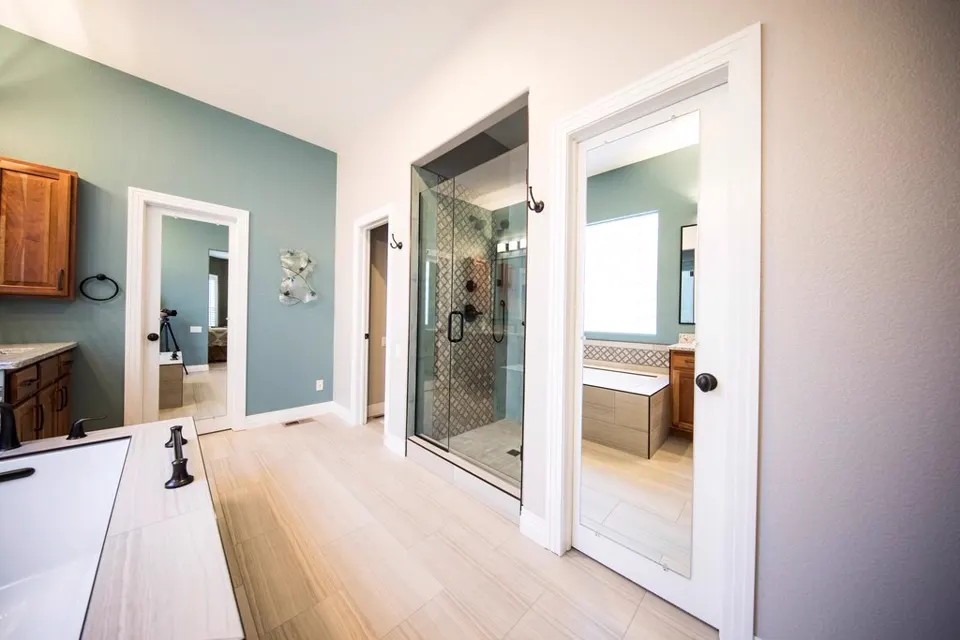
What does a bathroom renovation involve in India?
A full bathroom renovation in India usually means removing old tiles and fittings, replacing concealed plumbing, re-doing waterproofing, retiling walls and floor with correct slopes, and installing new sanitaryware, fittings, a vanity, lighting and ventilation. Waterproofing is the step you cannot see afterwards and the one you must not compromise on.
In Delhi NCR, most renovation requests come from homes that are 10 to 25 years old, where galvanised iron pipes have corroded, grout has cracked, and water is seeping into the walls of the neighbouring bedroom or the flat below. Hard water is another regional issue, leaving white scale on taps, glass and tiles. A good renovation fixes these problems at the root, not just the surface.
There are two scopes to consider:
- Refresh: new fittings, mirror, vanity, lighting and re-grouting, with existing tiles and plumbing retained. Suitable when there are no leaks.
- Full renovation: everything down to the brick, including plumbing and waterproofing. Necessary if there is seepage, loose tiles or old pipes.
Step-by-step bathroom renovation sequence
Follow this order: plan, demolish, fix plumbing and electrical, waterproof, test, tile, then install fittings. Changing the sequence is the most common cause of expensive rework.
- Plan and design: finalise the layout, wet and dry zones, fittings list and tile selection. Decide on a concealed cistern, wall-hung WC and shower position now.
- Demolition: remove tiles, sanitaryware and old pipes; break the floor down to the structural slab if waterproofing is failing. Inform your society and neighbours.
- Plumbing: lay new CPVC for hot and cold supply and UPVC or PVC for drainage, with proper gradients. Pressure-test the supply lines before closing.
- Electrical: provide points for geyser, exhaust fan, mirror light, and a shaver or hair-dryer socket at a safe distance from water, all on an RCCB-protected circuit.
- Waterproofing: apply the waterproofing system on floor and walls (details below).
- Flood test: fill the floor with water for 24 to 48 hours and check below for leaks.
- Screed and slope: lay the floor bed with a fall of about 1:60 to 1:100 towards the drain.
- Tiling: fix wall and floor tiles with polymer-modified tile adhesive; fill joints with epoxy grout.
- Fixtures: install sanitaryware, fittings, shower partition, vanity, mirror, accessories and lighting.
- Final checks: test water flow, drainage speed, hot water, fan and all electrical points.
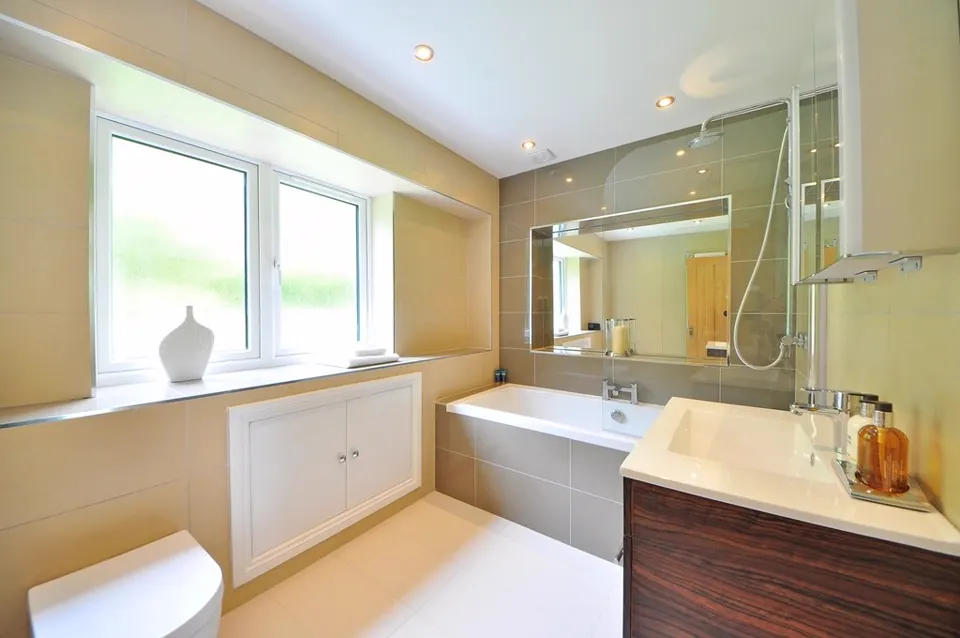

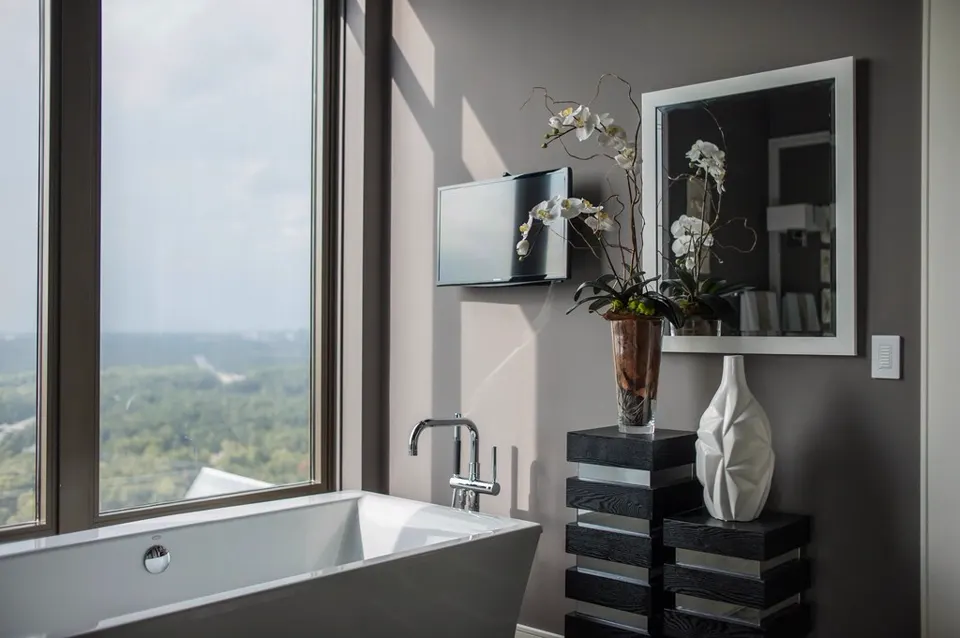
How should a bathroom be waterproofed?
Waterproof the entire floor and turn the membrane up the walls by at least 300mm, and up to about 1,800mm to 2,100mm in the shower area, with special attention to corners, pipe entries and the drain. Use a proven cementitious or polyurethane-based system applied in at least two coats.
- Surface preparation: clean the slab, repair cracks and make it smooth.
- Corner treatment: form cement coving or use reinforcement tape at wall-floor junctions.
- Pipe and drain collars: seal around every penetration with a compatible sealant or collar.
- Membrane: apply two coats of a flexible cementitious or PU coating in perpendicular directions; embed fibre mesh where recommended.
- Curing and testing: allow curing as per the product instructions, then flood test for 24 to 48 hours.
- Protection: protect the membrane with a screed before tiling so workers do not puncture it.
A reputable applicator and a written scope matter more than the brand. Ask exactly which product will be used, the coverage area and how the flood test will be done.
Tiles, sanitaryware and fittings: what to choose
Choose anti-skid floor tiles (R10 or higher slip rating, or a matte/rustic finish), large-format vitrified wall tiles with fewer joints, epoxy grout, wall-hung WCs with concealed cisterns, and fittings in chrome or PVD finishes that handle hard water better.
| Element | Recommended choice | Why |
|---|---|---|
| Floor tiles | Matte or anti-skid vitrified / porcelain | Safety for children and elders |
| Wall tiles | Large-format vitrified (600x1200mm) or slab tiles | Fewer joints, easier cleaning |
| Grout | Epoxy grout | Stain- and water-resistant, fewer fungus lines |
| WC | Wall-hung with concealed cistern | Easy floor cleaning, modern look |
| Shower | Wall mixer with overhead and hand shower; thermostatic valve if budget allows | Comfort and safety |
| Partition | 8mm to 10mm toughened glass | Keeps dry zone dry |
| Drain | Linear or anti-cockroach floor trap | Faster drainage, hygiene |
| Vanity | Wall-hung on BWP ply or WPC with quartz or solid-surface top | Moisture-resistant |
For vanities and storage, board choice matters; our plywood grades guide explains why BWP ply or WPC is preferred in bathrooms. For a design-led approach, see our bathroom interior design service.
How much does a bathroom renovation cost in Delhi NCR?
Indicatively, a full renovation of a standard 5 x 8 ft to 6 x 9 ft bathroom in Delhi NCR typically costs around ₹1.2 lakh to ₹3.5 lakh, with premium bathrooms going higher. Costs depend heavily on tile and fitting brands, the extent of plumbing and waterproofing, and glass partitions.
| Component | Indicative share of budget |
|---|---|
| Demolition and debris removal | 5% to 8% |
| Plumbing and electrical | 12% to 18% |
| Waterproofing | 8% to 12% |
| Tiles and tiling labour | 25% to 30% |
| Sanitaryware and CP fittings | 20% to 30% |
| Vanity, mirror, glass partition, lighting, accessories | 12% to 20% |
These shares are indicative and vary by project. A refresh without plumbing changes costs considerably less. For overall home budgets, see our interior design cost guide, and always ask for a site-specific quote after inspection.
Design ideas for small Indian bathrooms
Make a small bathroom feel larger with a clear glass partition, a wall-hung WC and vanity, large light-coloured tiles, a wall niche instead of shelves, and a big mirror with good lighting.
- Recessed shower niches (about 300mm wide x 600mm tall) keep bottles off the floor.
- Continue the same floor tile into the shower for visual continuity; use a linear drain.
- Use a backlit or front-lit mirror to avoid shadows on the face.
- Choose a compact wall-hung basin or a counter depth of 450mm in tight spaces.
- Place the exhaust fan high and opposite the door for cross-ventilation.
- Mount towel rails near the shower but outside the wet zone.
- Add a small ledge behind the WC for the flush plate and décor.
Timeline, hard water and common mistakes
A full bathroom renovation typically takes two to four weeks, including curing and flood testing time. Rushing waterproofing to save a few days is the most costly mistake.
Handling hard water
Many parts of Faridabad and Gurgaon have hard water. Consider a whole-house or bathroom-line water softener, choose fittings with good coatings, use water-repellent coatings on glass partitions, and wipe glass and taps after use to reduce scale.
Mistakes to avoid
- Tiling over old tiles without checking for hollowness and leaks.
- Skipping the flood test.
- Insufficient floor slope, which leaves standing water.
- Using MR-grade boards for vanities.
- Glossy floor tiles that become slippery.
- No access panel for the concealed cistern.
- Electrical points too close to the shower.
Bathrooms are often part of a larger refresh; our guide on renovating an old house shows how to sequence them with other rooms. When you are ready to plan yours, call Asaya Interiors on +91 98001 08800 for a site inspection and a transparent, itemised renovation plan, or read more about our renovation service.
Frequently asked questions
How much does bathroom renovation cost in India?
Indicatively, a full renovation of a standard bathroom in Delhi NCR typically costs around ₹1.2 lakh to ₹3.5 lakh, depending on tiles, fittings, plumbing and waterproofing scope. Premium bathrooms cost more. A site inspection is needed for an accurate estimate.
How long does a bathroom renovation take?
A full bathroom renovation usually takes two to four weeks, including demolition, plumbing, waterproofing curing, a flood test, tiling and installation of fittings. A simple refresh can be completed in a few days.
Can new tiles be laid over old bathroom tiles?
It is possible only if the old tiles are firmly bonded, level and there is no leakage. In most older bathrooms, removing the tiles and redoing waterproofing is the safer long-term option.
What is the best waterproofing for a bathroom floor?
A flexible cementitious or polyurethane-based membrane applied in at least two coats, with corner treatment, sealed pipe entries and a 24 to 48 hour flood test, is a reliable approach when applied by an experienced team.
Is a wall-hung toilet a good choice for Indian homes?
Yes, wall-hung WCs with concealed cisterns are popular because they make floor cleaning easy and look modern. Ensure a strong frame, a quality cistern and an accessible service panel behind the flush plate.
How do I prevent hard water stains in a new bathroom?
Install a water softener where possible, choose fittings with durable finishes, apply a water-repellent coating on glass, and wipe glass and taps dry after use to reduce limescale build-up.